Key Takeaways
- Positive reinforcement training uses rewards to increase desired behaviors, making it both effective and enjoyable for dogs.
- Dogs trained with positive methods show increased confidence, reduced anxiety, and stronger bonds with their owners.
- The science of operant conditioning explains why rewards work better than punishment for long-term behavior change.
- While highly effective, positive reinforcement requires good timing, consistency, and gradual reward fading to prevent treat dependency.
- PetMaster Training Academy’s approach combines positive techniques with practical application for real-world results.
Training your dog shouldn’t feel like a power struggle. When your furry friend eagerly responds to commands with a wagging tail instead of reluctant compliance, you’re witnessing the magic of positive reinforcement in action.
Traditional training methods often relied on corrections and dominance, but modern dog training has evolved significantly. Positive reinforcement has emerged as the gold standard, backed by science and endorsed by professional trainers worldwide. But what exactly makes this approach so effective, and does it have any limitations you should be aware of?
Why Positive Reinforcement Works Wonders for Dogs
Positive reinforcement training focuses on rewarding behaviors you want to see more of, rather than punishing those you don’t. When your dog sits, comes when called, or walks politely on leash, they receive something valuable to them – a treat, praise, play, or access to something they desire. This creates a powerful connection in their mind: “When I do this, good things happen!”
Dogs are natural problem-solvers. They’re constantly figuring out what works to get what they want. By using positive reinforcement, you tap into this natural learning style, making training feel less like work and more like a fun game that benefits both of you. PetMaster Training Academy has found that dogs trained with positive methods learn faster and retain their training longer than those trained with primarily corrective techniques.
The beauty of positive reinforcement lies in its simplicity. You don’t need special equipment or physical strength – just an understanding of what motivates your specific dog and good timing with rewards. This makes it accessible to everyone, regardless of age, size, or physical ability.
The Science Behind Positive Reinforcement Training
The effectiveness of positive reinforcement isn’t just anecdotal – it’s rooted in decades of scientific research on how animals learn. This approach stems from the principles of operant conditioning, first documented by psychologist B.F. Skinner. These principles explain how consequences influence behavior, with animals naturally repeating actions that lead to pleasant outcomes.
When your dog receives something valuable immediately after performing a desired behavior, neural pathways strengthen in their brain. This biological process makes the behavior more likely to be repeated in the future. It’s not about bribing your dog – it’s about creating lasting associations between actions and positive outcomes.
- Positive reinforcement: Adding something pleasant to increase behavior
- Negative reinforcement: Removing something unpleasant to increase behavior
- Positive punishment: Adding something unpleasant to decrease behavior
- Negative punishment: Removing something pleasant to decrease behavior
How Dogs Learn Through Operant Conditioning
Dogs are constantly learning, whether we’re actively training them or not. Every interaction teaches them something about how their world works. When a dog jumps up and receives attention (even negative attention), they’re learning that jumping works to get a reaction. When they sit and receive a treat, they learn sitting pays off.
Timing is crucial in this learning process. For a dog to make the connection between their action and the consequence, the reward must come within 1-2 seconds of the behavior. This is why clickers and marker words are so effective – they bridge the gap between the behavior and the reward delivery, telling the dog precisely which action earned the payoff.
The Four Quadrants of Dog Training
Operant conditioning encompasses four different ways to influence behavior, known as the four quadrants. Each involves either adding or removing something, and either strengthening or weakening a behavior. Understanding these quadrants helps you make informed choices about your training approach.
While all four quadrants can effectively change behavior, they don’t all have the same psychological impact on your dog. Positive reinforcement (adding something good) and negative punishment (removing something good) are considered the more humane approaches, as they avoid using fear, pain, or intimidation. These “positive” methods work with your dog’s natural learning processes rather than against them.
The psychological effects of aversive techniques can include increased stress, anxiety, and fear – sometimes directed at the trainer. In contrast, positive methods build trust and enthusiasm for training sessions. This explains why most modern professional trainers focus primarily on positive reinforcement, supplemented with gentle negative punishment (like briefly removing attention for unwanted behaviors).
Why Positive Reinforcement is the Most Effective Quadrant
Among the four quadrants, positive reinforcement stands out for several key reasons. First, it clearly communicates what you want, rather than just what you don’t want. When you reward sitting, your dog learns “sitting is what works,” not just “jumping doesn’t work.” This clarity accelerates learning and reduces frustration for both of you.
Second, positive reinforcement creates positive emotional associations with training, with you as the trainer, and with the behaviors themselves. Your dog doesn’t just learn to sit – they learn to love sitting because good things happen when they do. This emotional component creates more durable behaviors that stand up better under distraction. For more insights, check out this complete guide to dog training services.
Finally, positive reinforcement preserves and enhances your relationship with your dog. Rather than seeing you as someone who controls resources or delivers corrections, your dog views you as a partner who makes good things possible. This foundation of trust makes all future training more effective and enjoyable.
6 Major Benefits of Reward-Based Training
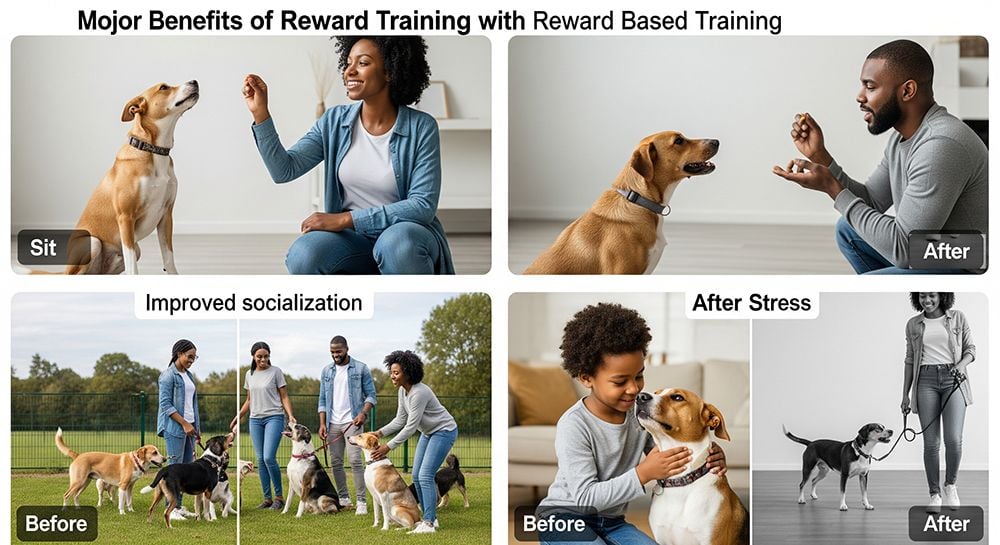
When implemented correctly, positive reinforcement delivers remarkable results that extend far beyond basic obedience. Dogs trained with rewards develop confidence, enthusiasm, and a genuine desire to work with their handlers. This approach transforms training from a series of commands into a collaborative partnership that both species enjoy.
Research consistently shows that reward-based methods produce fewer behavioral problems compared to punishment-based approaches. A 2017 study published in the Journal of Veterinary Behavior found that dogs trained primarily with positive reinforcement showed significantly lower stress levels and fewer problem behaviors than those trained with aversive methods.
“Dogs trained with positive reinforcement are more likely to offer new behaviors, solve problems creatively, and maintain their training even without constant rewards. They’re working with you, not just for you.” – Dr. Karen Overall, Veterinary Behaviorist
Let’s explore the six most significant benefits of choosing positive reinforcement for your dog’s education.
1. Stronger Bond Between Dog and Owner
Perhaps the most valuable outcome of positive training is the deep trust and connection it builds between you and your dog. When you become a reliable source of good things rather than corrections, your dog naturally gravitates toward you and values your attention. This foundation of trust makes everything else in your relationship easier, from veterinary visits to handling emergencies.
Dogs trained with positive methods actively seek interaction with their owners, making everyday life more enjoyable for both parties. They’re more likely to check in, maintain eye contact, and remain engaged during activities. This psychological connection creates a responsive dog who wants to work with you rather than one who simply complies to avoid consequences.
2. Increased Training Engagement and Enthusiasm
Dogs trained with positive reinforcement develop what trainers call a “joy of work” – they find the training process itself rewarding and fun. This intrinsic motivation makes them eager participants rather than reluctant followers. You’ll notice your dog offering behaviors, paying attention more consistently, and showing excitement when they see training equipment come out.
This enthusiasm for learning creates a positive feedback loop. The more your dog enjoys training, the more they’ll engage with it. The more they engage, the more they learn. And the more they learn, the more confident and capable they become in all aspects of life. For a comprehensive understanding of how training can transform your dog’s behavior, check out this guide on dog behavior transformation.
Training sessions become highlights of your dog’s day rather than obligations, leading to faster progress and better retention of skills. Dogs who find learning rewarding will continue to offer behaviors even when rewards become intermittent. For more on improving your dog’s behavior, check out Elite Professional Dog Training’s services.
3. Mental Stimulation and Problem-Solving Skills
Positive reinforcement training provides vital mental exercise for dogs of all ages. The process of figuring out what behaviors earn rewards is inherently stimulating, engaging your dog’s natural intelligence and problem-solving abilities. This mental workout can be just as tiring as physical exercise, helping to fulfill your dog’s needs for cognitive stimulation.
Dogs who learn through positive methods develop better problem-solving skills and adaptability. They become more creative in their thinking and more resilient when facing new challenges. This cognitive flexibility makes them better companions who can handle novel situations with confidence rather than fear or frustration.
For working breeds especially, this mental stimulation fulfills a crucial need. Breeds developed for complex tasks need mental challenges as much as physical ones, and positive training provides both simultaneously.
4. Reduced Stress and Anxiety
Training sessions should never be sources of stress or anxiety for your dog. Positive reinforcement creates a low-stress learning environment where dogs can experiment safely without fear of making mistakes. This psychological safety is particularly important for sensitive, fearful, or previously traumatized dogs.
When dogs learn without fear of correction, their overall stress levels decrease. They become more confident in their abilities and more willing to try new things. This reduction in stress has far-reaching benefits for behavior, health, and overall quality of life. Studies have shown that chronically stressed dogs display more problem behaviors and may even have shortened lifespans.
The confidence built through positive experiences generalizes to other situations, helping dogs become more resilient and balanced in all aspects of life. They learn that the world is predictable and that they have some control over outcomes – key factors in canine emotional well-being.
5. Better Long-Term Behavior Retention
Behaviors learned through positive reinforcement tend to be more durable and resistant to extinction. When dogs understand what works to earn rewards, rather than just what to avoid to prevent punishment, they develop stronger associations that last longer, even without constant reinforcement.
This permanence comes from the emotional component of positive learning. Dogs aren’t just memorizing commands – they’re developing positive feelings about the behaviors themselves. These emotional connections create stronger, more resilient neural pathways that withstand the tests of time and distraction. For more insights, check out this article on operant conditioning and positive reinforcement.
6. Fewer Unwanted Side Effects
Perhaps most importantly, positive reinforcement avoids the harmful side effects associated with punishment-based methods. Aversive training techniques can create fallout such as increased aggression, fear, anxiety, and damaged trust. Dogs may comply out of fear while developing negative associations with the trainer, the training environment, or even specific commands. For a deeper understanding of these methods, explore the complete guide to dog training services available.
Positive methods, when applied correctly, don’t carry these risks. Even when mistakes occur (as they inevitably will), the worst outcome is usually temporary confusion rather than lasting psychological harm. This makes positive reinforcement not only more effective but significantly safer for your dog’s mental and emotional health.
Choosing the Right Rewards for Your Dog
The cornerstone of successful positive reinforcement is selecting rewards your dog truly values. Not all dogs are motivated by the same things, and understanding your individual dog’s preferences will dramatically improve your training outcomes. What works for one dog may hold little interest for another, making reward selection a personalized process.
The most effective rewards are those your dog will work for under various conditions and distraction levels. Many trainers establish a hierarchy of rewards, ranging from everyday low-value reinforcers to high-value special treats reserved for challenging situations or new behaviors. This strategic approach ensures you always have the right motivational tool for the job. For more insights, check out Orlando, Florida’s best dog trainer for expert advice on dog training techniques.
Food Rewards: When and How to Use Them
Food is the most common and usually most effective reward in dog training. It’s quick to deliver, easy to carry, and motivating for most dogs. Food rewards work particularly well for initial learning phases because they can be delivered rapidly and precisely, allowing for high rates of reinforcement. Small, soft, and aromatic treats work best as they can be consumed quickly without interrupting the training flow.
For maximum effectiveness, save special high-value treats (like small pieces of cheese, cooked meat, or commercial training treats) for challenging environments or difficult behaviors. Use your dog’s regular kibble or lower-value treats for easier tasks or familiar environments. This creates a clear distinction that helps your dog understand when they’ve done something particularly impressive versus merely satisfactory. For more advanced techniques, consider exploring professional dog training services.
Inconsistent Reward Delivery
One of the biggest mistakes dog owners make is inconsistent reinforcement timing. If your reward comes too late, your dog associates it with whatever they were doing at that moment—not the behavior you intended to reinforce. This creates confusion and frustration for your dog, who can’t figure out what exactly earns the reward. For optimal results, deliver reinforcement within 1-2 seconds of the desired behavior, using a marker word or clicker to “bridge” any delay if needed.
Using Low-Value Rewards for Difficult Tasks
Trying to teach a challenging behavior in a distracting environment with basic kibble is like asking someone to work overtime for standard pay—it’s simply not motivating enough. Match your reward value to the difficulty level of what you’re asking. Everyday behaviors in your living room might work fine with regular treats, but expecting your dog to ignore other dogs at the park requires premium rewards like chicken, cheese, or steak. Save your highest value treats for your most challenging training scenarios to maintain motivation and focus.
Forgetting to Fade Out Food Rewards
- Gradually increase the number of behaviors before each reward
- Introduce variable reward schedules where treats become unpredictable
- Incorporate life rewards (play, access to outdoors, etc.) alongside food
- Practice in increasingly distracting environments before reducing rewards
Many owners make the mistake of using food rewards too predictably and for too long without a fading plan. Eventually, your dog needs to respond reliably without expecting a treat every single time. The solution isn’t to suddenly stop treating altogether, but to implement a systematic fading process where rewards become less predictable and more intermittent.
Remember that behaviors reinforced on a variable schedule (where rewards come unpredictably) are actually stronger and more resistant to extinction than those reinforced every time. This mimics natural reinforcement patterns in the environment, where payoffs don’t always come with every attempt. Dogs who understand this concept will continue performing behaviors even when rewards aren’t immediately apparent. For more insights on dog training, explore the complete guide to dog training services.
Start by asking for two behaviors before rewarding, then three, and so on. Mix in verbal praise and life rewards alongside treats. Gradually thin out your treat delivery while maintaining enthusiasm and clear feedback. The goal isn’t to eliminate rewards completely but to make them less predictable and to broaden what your dog finds reinforcing. For more insights, check out transform your dog’s behavior.
The fading process should be gradual enough that your dog remains motivated throughout. If you notice performance declining, you’ve likely reduced rewards too quickly. Take a step back, increase the reward rate temporarily, and then proceed more slowly with the fading process.
Combining Positive Reinforcement with Other Methods
While positive reinforcement forms the foundation of effective modern training, it works best when strategically combined with other humane approaches. Most professional trainers don’t rely exclusively on one technique but create comprehensive programs that address both encouraging good behavior and discouraging unwanted behavior. The key is selecting additional methods that maintain trust and enthusiasm rather than creating fear or avoidance.
Balanced Use of Negative Punishment
Negative punishment—removing something desirable to decrease unwanted behavior—pairs naturally with positive reinforcement. For example, if your dog jumps up for attention, briefly turning away (removing the opportunity for attention) teaches them that jumping makes good things go away. When they sit instead, attention returns as positive reinforcement. This combination clearly communicates both what works and what doesn’t without causing fear or pain, making it particularly effective for attention-seeking behaviors like jumping, barking, or pawing.
When Traditional Methods Might Be Necessary
In some limited situations, particularly those involving safety concerns, trainers may incorporate carefully applied aversives or management techniques alongside positive reinforcement. For example, a properly fitted head halter might be used temporarily to manage a strong dog who pulls dangerously, while positive reinforcement teaches the long-term skill of loose-leash walking. These tools should be viewed as temporary management aids rather than training solutions in themselves.
It’s important to distinguish between thoughtful, minimal use of aversives in specific circumstances versus reliance on punishment as a primary training strategy. The latter approach risks psychological damage and relationship problems that far outweigh any short-term compliance gains. When considering any method involving aversives, ask whether there’s a positive alternative that could accomplish the same goal without potential side effects.
Creating a Complete Training Program
A comprehensive approach to dog training integrates multiple components: positive reinforcement to teach desired behaviors, humane negative punishment to address unwanted behaviors, environmental management to prevent rehearsal of problematic patterns, and clear, consistent communication throughout. This multi-faceted approach addresses immediate behavioral concerns while building the skills and relationship necessary for long-term success. Rather than viewing training methods as competing philosophies, think of them as different tools in your toolkit—with positive reinforcement being the most frequently used and versatile tool that forms the foundation of your approach.
Real Results: Transform Your Dog’s Behavior with Positive Methods
The proof of any training methodology lies in its results, and positive reinforcement consistently delivers remarkable transformations in real-world situations. Dogs who were once fearful or reactive can learn confidence and self-control. Hyperactive puppies develop impulse control and focus. Even serious behavioral issues like resource guarding and aggression respond better to carefully implemented positive approaches than to force or intimidation. The key is consistency, patience, and a willingness to understand the underlying needs and motivations driving your dog’s behavior.
Success stories abound of dogs who failed with traditional methods but thrived when switched to positive reinforcement. These aren’t just easy cases or naturally compliant dogs—many were considered “last chance” cases before positive methods turned things around. What these transformations share is a focus on building alternative behaviors rather than simply suppressing unwanted ones, addressing root causes rather than symptoms, and maintaining the dog’s trust throughout the rehabilitation process.
Frequently Asked Questions
Many dog owners have questions or concerns about implementing positive reinforcement, especially if they’re transitioning from more traditional methods. These questions often reflect common misconceptions about what positive training involves and what it can achieve. Understanding the science and practical application behind this approach can help clarify these concerns and set realistic expectations for your training journey.
Below we address the most common questions dog owners ask when considering or implementing positive reinforcement training. These answers combine scientific research with practical experience to give you a complete picture of what to expect when training your dog with rewards.
“The beautiful thing about positive reinforcement is that it’s not just effective—it transforms the entire experience of living with a dog. Training becomes something both species enjoy rather than endure, creating willing partners instead of reluctant followers.” – Jean Donaldson, Founder of The Academy for Dog Trainers
While every dog is unique in their learning style and motivations, the principles of positive reinforcement are universally applicable. The following answers can help you tailor this approach to your specific dog and situation.
How long does it take to see results with positive reinforcement training?
Many owners see immediate improvement in simple behaviors within the first few training sessions. Your dog may learn a basic sit or touch command in just minutes using positive reinforcement. However, building reliability, duration, and performance under distraction takes consistent practice over weeks or months. Complex behaviors, behavior modification for fear or aggression issues, or retraining a dog with a long history of reinforcement for unwanted behaviors will naturally take longer—typically 3-6 months of consistent work for significant change.
The timeline also depends heavily on your consistency, training frequency, and skill level. Dogs who receive clear, consistent reinforcement in daily short sessions progress much faster than those trained sporadically or with confusing criteria. With positive reinforcement, you’re building new neural pathways and emotional associations, which takes repetition and time—but the results are more permanent and more enjoyable for both you and your dog.
Can positive reinforcement work for aggressive dogs?
Positive reinforcement is actually the method of choice for addressing aggression, as punishment-based approaches often worsen aggressive responses by increasing fear and anxiety. By reinforcing alternative behaviors and changing emotional associations, positive methods address the underlying causes of aggression rather than just suppressing the visible symptoms. This approach helps dogs learn better coping mechanisms and develop more positive emotional responses to their triggers.
Aggression Type | Positive Reinforcement Approach |
|---|---|
Fear-based | Counter-conditioning to create positive associations with triggers; reinforcing calm behaviors |
Resource guarding | Teaching that people approaching resources predicts even better things; reinforcing voluntary sharing |
Territorial | Rewarding alternative behaviors to barking/charging; controlled exposures with reinforcement for calmness |
Frustration-based | Teaching impulse control; reinforcing patience; providing appropriate outlets for energy |
That said, aggressive behavior requires a careful, structured approach ideally guided by a professional trainer or behaviorist. The key is identifying the underlying emotion driving the aggression and addressing that root cause rather than just the visible symptoms. For safety reasons, management strategies (like muzzle training or avoidance of triggers) should be implemented alongside positive training when working with aggression.
Success may take longer with aggression cases, but positive methods offer the advantage of improving the dog’s emotional state while building new behaviors—addressing both the visible aggression and its underlying causes simultaneously.
Do I always need treats for positive reinforcement training?
While food rewards are typically the most efficient reinforcer during initial training stages, positive reinforcement encompasses many types of rewards beyond treats. As training progresses, you can incorporate praise, play, toys, access to environments (going outside), or other activities your dog values. The definition of a reinforcer is simply anything that increases the likelihood of a behavior being repeated—so anything your dog finds rewarding can strengthen behaviors. Many experienced trainers eventually transition to using primarily “life rewards” for maintained behaviors, while still keeping food rewards available for teaching new skills or working in challenging environments. For more insights on advanced training techniques, check out Orlando Florida’s Best Dog Trainer.
Will my dog only behave when I have treats if I use positive reinforcement?
This common concern reflects a misunderstanding of how reinforcement schedules work. When implemented correctly, positive reinforcement includes a systematic plan for fading food rewards from continuous reinforcement (treating every time) to intermittent reinforcement (treating unpredictably). Behaviors maintained on variable reinforcement schedules actually become stronger and more resistant to extinction than those reinforced every time. This is why gambling is so addictive for humans—the unpredictable nature of the reward makes the behavior more persistent. By gradually making treats less predictable rather than eliminating them completely, you’ll build behaviors that maintain even when rewards aren’t immediately visible.
Can positive reinforcement be used for older dogs who were trained differently?
- Yes, dogs of any age can learn through positive reinforcement
- Older dogs often respond especially well to the clarity of reward-based methods
- Previous training history may require some adjustment period as the dog learns the new system
- Consistency is key during the transition to prevent confusion
Dogs are remarkably adaptable learners throughout their lives. Older dogs can absolutely learn through positive reinforcement, and many actually thrive when switched from correction-based methods to reward-based training. The clarity of knowing exactly what works (instead of just what doesn’t) often comes as a relief to dogs previously trained with primarily aversive methods.
When transitioning an older dog to positive methods, patience is important as they learn the new “rules of the game.” Some dogs may initially seem confused when corrections disappear and rewards appear, but most quickly catch on to the new system and become enthusiastic participants once they understand how it works.
Start with simple behaviors the dog already knows, pairing them with rewards to establish the new pattern. Then gradually introduce new cues or refine existing behaviors using positive methods. This creates a smooth transition that builds on the dog’s existing knowledge while introducing the benefits of a more positive approach.
Many owners report that their relationship with their older dog improves dramatically after switching to positive methods, as the training process becomes more enjoyable for both parties.
The keys to success lie in consistency, clear communication, and patience during the transition period. With these elements in place, dogs of any age can flourish with positive reinforcement training.
Work With Elite Professional Dog Training
Ready to see this with your own dog? Explore our Board & Train Boot Camp and Train & Play in Sanford & Orlando, FL, or book your free evaluation today.